



Somaliland’s National Rainwater Harvesting Programme secured nearly USD 2 million in new dam funding and inspired a wave of household-level water conservation — powered by a communication strategy built from the ground up.
 A Country Losing Water It Could Not Afford to Lose
Every rainy season, Somaliland receives a resource it desperately needs and largely fails to keep. Rain that falls across the Gu and Deyr seasons runs off the land, through the wadis, and out to sea, while communities a few kilometres away continue to haul water over long distances or pay high prices for trucked supply. The Ministry of Water Resources Development (MoWRD) had long identified rainwater harvesting as one of the most direct ways to close that gap. What the sector lacked was not technical knowledge, but public attention, political momentum, and the funding that follows both.
That changed with the launch of “Gacmahaaga Biyo kaga Dharag” — “Fill Your Hands with Water” — the Ministry’s National Rainwater Harvesting campaign, and the wider public awareness effort built around it.
Building the Campaign from the Communication Function Up
At the time, Sa’ad Aw Muuse led the Ministry’s Media and Communication Department, and served as Team Leader for the rainwater harvesting campaign. His mandate spanned three connected functions: event management for the Ministry’s flagship public activities, the Ministry’s digital transformation efforts, and community engagement work with the citizens the Ministry ultimately serves. Across all three, Sa’ad was the backbone of the campaign — the person who carried it from concept through to the results the Ministry now points to as a benchmark.
Rather than treating communication as an afterthought to the technical programme, Sa’ad’s team built it into the campaign’s foundation. A digital media strategy was designed to carry a single, memorable message to two very different audiences at once — policymakers who controlled budget decisions, and households who controlled whether a berkad got built outside their own front door. The centrepiece was the “Gacmahaaga Biyo kaga Dharag” National Rainwater Harvesting Conference, held on 5 February 2021, convened to open the wider National Rainwater Harvesting Programme and to place rainwater harvesting firmly on the public and political agenda.
From Awareness to Investment
The campaign’s impact reached well beyond public sentiment. Under Sa’ad’s leadership, the communication strategy generated enough momentum that the Ministry secured commitment from the Office of the President and the Ministry of Finance to fund four major dams, with a combined value of close to USD 2 million — a rare scale of direct infrastructure investment tied to a public awareness campaign. The dams approved and now referenced in follow-up were sited at Xaaji Saalax, Caynabo, Ceel-afweyn, and Oodweyne.
The campaign’s reach extended to institutions beyond the Ministry itself. The Hargeisa Water Agency, influenced by the same public momentum Sa’ad’s team had built, went on to implement its own dam project valued at roughly USD 1 million — evidence that the campaign he led had shifted how the wider water sector, not just MoWRD, prioritised rainwater harvesting.
A Change Visible at the Household Level
Perhaps the clearest measure of success was the one the campaign could not mandate: what people chose to build with their own resources. Following the campaign Sa’ad led, a significant number of households began incorporating berkads — household rainwater storage tanks — into new home construction, capturing water that would otherwise have been lost as runoff into the sea. For a country where freshwater is scarce and every millimetre of rainfall matters, this shift in household behaviour represented exactly the kind of durable, self-sustaining change public campaigns aim for but rarely achieve — and it traced directly back to the communication strategy Sa’ad had designed.
Why Digital Media Made the Difference
The scale of this outcome was not incidental to the communication strategy Sa’ad built — it was a direct result of it. Three features of his digital media approach stood out:
- Reach across two audiences at once. The same campaign narrative that mobilised households to build berkads also reached decision-makers in the Presidency and Ministry of Finance, aligning public demand with the political case for funding.
- A single, memorable message. “Gacmahaaga Biyo kaga Dharag” gave a technical water-management issue a message people could repeat and act on, rather than a set of statistics they would forget.
- Anchoring digital reach to a real event. The national conference gave the digital campaign a moment to build toward and report from, generating a sustained content cycle rather than a single announcement.
For future campaigns across the water sector and beyond, this experience offers a replicable model: treat communication as core programme infrastructure, not a closing activity; design the message for the audience that funds the work and the audience that must adopt it, in the same breath; and use digital channels to compound the reach of a single flagship event long after the event itself has ended.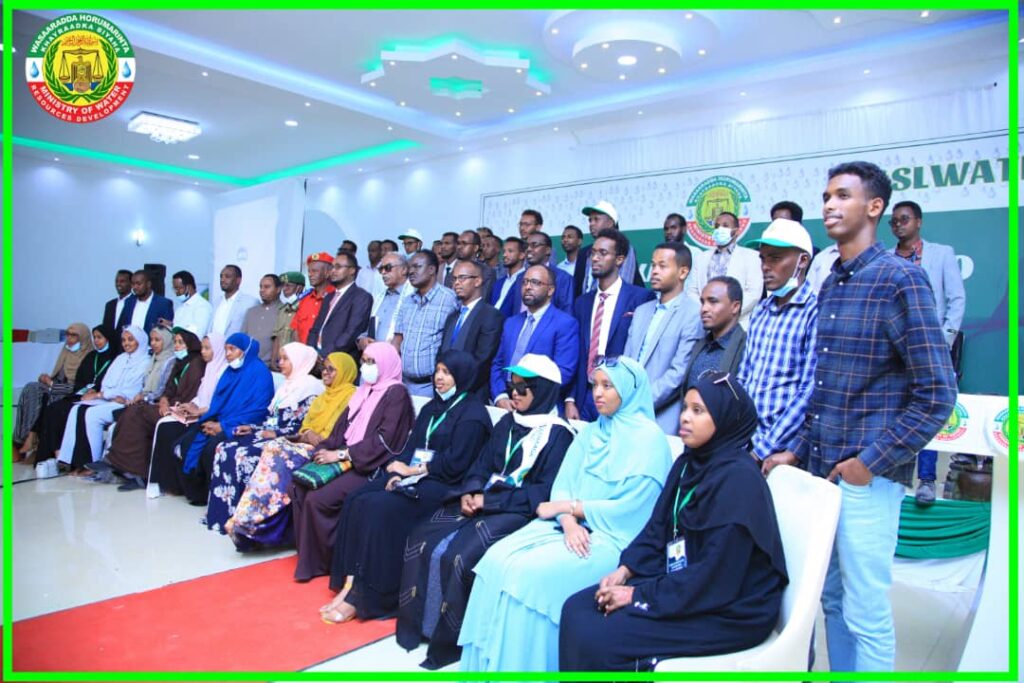
Looking Ahead
“Gacmahaaga Biyo kaga Dharag” demonstrated that a well-run digital media campaign can do more than raise awareness — it can unlock capital investment and change household behaviour in the same cycle. That demonstration exists because Sa’ad Aw Muuse was willing to put communication at the centre of a technical programme and see it through, from the first digital post to the dams now under construction. As Somaliland continues to confront water stress and rainfall variability, the combination of political mobilisation and grassroots adoption that Sa’ad pioneered offers a template the Ministry of Water Resources Development, and other institutions, can build on for the campaigns still to come.